What to Look For in a Personal Trainer for Women
A buyer's guide, not a listicle: what certifications actually mean, what a real first session looks like, the questions to ask, and the red flags to walk from.
Hiring a personal trainer is a buying decision, and it deserves to be treated like one. Most advice on choosing a personal trainer for women reads like a personality quiz — find someone supportive, someone who "gets you." That is not wrong, but it will not stop you paying for months of generic circuits, an unqualified coach, or a plan that ignores how your body actually works. So this is a buyer's guide instead: what a certification really means, what should happen in your first session, the exact questions to ask on a trial, the red flags that should make you walk, and how good coaching handles the parts of training that are different for women. Read it even if you never train with us — it will make you a sharper judge of whoever you choose.
What a personal trainer's certification actually tells you
"Certified" is the most abused word in fitness. Anyone can buy a one-day online course, download a PDF, and call themselves a coach the next morning. So the useful skill is not asking whether someone is certified — it is knowing which certifications mean something.
The credentials worth respecting are the ones that have been checked by an independent body, not just self-awarded by the school selling the course. In the exercise field, personal-training certifications from organisations such as the American Council on Exercise (ACE), the American College of Sports Medicine (ACSM) and the National Strength and Conditioning Association (NSCA) are accredited by the National Commission for Certifying Agencies (NCCA) — described by ACE as "the gold standard when it comes to accreditation of programs that certify professionals" (ACE). Accreditation means a third party has verified that the exam is valid, competency-based and reliable — in plain terms, that passing it actually proves the person knows what they are doing.
That is the real dividing line: an accredited certification with a proctored exam and ongoing continuing-education requirements sits in a completely different category from a weekend certificate handed out for watching a few videos. You are allowed to ask which one your trainer holds. A good coach will tell you the specific credential — the letters, the body, and when they last renewed it — without getting defensive.
Certification is a floor, not a ceiling
Here is the honest limit of any certificate, though: it proves a trainer cleared a real bar of general knowledge. It does not prove they will watch how you actually move, adapt your plan as your body changes, or know when to bring your doctor into the conversation. Those things separate a genuinely good coach from a merely qualified one, and you can only judge them in a real session — which is where the rest of this guide comes in. For health conditions especially, look past the base certificate for extra education and a habit of coordinating with your doctor.
What a real first session looks like
You learn more about a trainer in the first thirty minutes than in any brochure. The tell is simple: a good first session is mostly listening and watching you move — not a punishing workout designed to impress you. A coach who makes you feel wrecked on day one is selling a feeling, not building a plan.
A proper first session — an assessment — should cover three things before you touch a real weight:
- Your history and health. Injuries, surgeries, medications, any diagnosed conditions (thyroid, PCOD, diabetes, back problems), pregnancy or postpartum status, sleep, stress and how you actually eat. If a trainer never asks about your health, they cannot train you safely — full stop.
- A movement screen. How you squat, hinge, push, pull and balance; where you feel tight or where something pinches. This is how a coach spots what to build and what to protect.
- Baselines they write down. A few strength markers, key measurements, how you feel and move today — recorded, so that in eight weeks there is something real to compare against instead of a vague "you're doing great."
If you have never trained before, this assessment matters even more — it is the difference between a plan built for your body and a template built for nobody. That careful, unhurried start is exactly what one-on-one attention is for, and it is the whole premise of working with a personal trainer for beginners in Pune.
Ten questions to ask before you sign
Take these to a trial session or a consultation. This is not being difficult — it is due diligence on something you will pay for and trust with your body. Next to each is what a good answer sounds like.
- What certification do you hold, and is it accredited? Good answer: a specific, named credential (ACE, ACSM, NSCA or similar) they can show you.
- How will you assess me before we start? Good answer: a described process — history, movement screen, baselines — not "we'll just jump in."
- Have you trained women with my situation before? (Postpartum, PCOD, thyroid, back pain, complete beginner.) Good answer: honest experience, or an honest "no, but here is how I'd coordinate it."
- How does the plan change over time? Good answer: it is adjusted to how you progress and feel — not one PDF you keep forever.
- How do you handle a low-energy or mid-cycle day? Good answer: they adapt the load; they do not guilt you into pushing through everything.
- Is nutrition included, or separate? Good answer: a clear answer either way — and if included, who actually writes it.
- How and how often do you track progress? Good answer: more than the scale — strength, measurements, energy, how you feel.
- What happens if I get injured or have pain? Good answer: they modify and, when needed, refer you to a doctor or physio — they do not tell you to push through.
- Can I train with a female coach if I'd prefer? Good answer: a straight yes or no, treated as a normal request, not talked out of.
- What does the price include, exactly? Good answer: a clear breakdown of what is and is not in the fee (more on reading price below).
Green flags vs red flags: reading a trainer in one session
You do not need months to tell a good coach from a risky one. Most of the signals show up in the first conversation. Here is what to weigh.
| What you are watching | Green flag | Red flag |
|---|---|---|
| Certification | Names a specific accredited credential, happy to show it | Vague "I'm certified," changes the subject |
| First session | Assessment first — questions and a movement screen | Straight into a max-effort workout to "test" you |
| Your health history | Asks in detail and writes it down | Never asks about conditions, medications or pregnancy |
| The plan | Personalised and adjusted as you progress | The same template handed to everyone |
| Pain and injury | Modifies, and refers to a doctor when needed | "Push through it — pain is weakness" |
| Focus of the work | Strength, energy, how you function and feel | Fixated on your weight and appearance |
| Progress | Tracked across several measures | No tracking, or the scale used to shame you |
| Your comfort | Respects boundaries; female coach available on request | Stands too close, dismisses your preferences |
The reason these red flags are red is worth understanding, not just memorising. A trainer who skips your health history can prescribe exactly the movement your back or your postpartum core is not ready for. One who hands everyone the same plan is charging a personal-training price for a group product. "Push through the pain" is dangerous because pain is information — how your body flags that a joint, disc or healing tissue is being loaded wrong. And a coach fixated on your weight tends to steer you toward the exact under-eating-plus-over-exercising pattern that does real harm — the next thing worth understanding.
How good coaching handles the female body — without gimmicks
There are two ways trainers get women's training wrong. The first is to pretend there is no difference and hand you the same plan as the man next to you. The second — somehow worse — is to overdo the difference: pink dumbbells, "toning" that means never lifting anything real, and a quiet assumption that you are fragile. A good coach does neither. They train you as strong and capable, while respecting the ways your physiology genuinely differs.
Energy across the month — and the danger of under-fuelling
Across a monthly cycle, hormones shift, and with them energy, strength and recovery. The research on training specifically around the cycle is still developing, so be wary of anyone selling a rigid "cycle-syncing" system as settled science. The sound principle is simpler: a good coach reads how you are actually feeling and adjusts the load — pushing when your body is primed, easing off when it is not — without making you feel guilty for a slow week.
The genuinely important, evidence-backed point here is about fuelling. Chronically eating too little for how much you train — low energy availability — is a recognised syndrome (Relative Energy Deficiency in Sport, or REDs) that harms female health, including menstrual function and bone health, per the International Olympic Committee's expert consensus (IOC, 2023). This is exactly why a coach who is obsessed with cutting your calories and appearance is a risk, not a motivator. Good coaching feeds your training; it does not starve it.
PCOD, thyroid and other hormonal conditions
If you are managing PCOD, PCOS or a thyroid condition, training and nutrition should be coordinated for hormonal balance — and, where it matters, coordinated with your doctor rather than guessed at. A trainer who claims to "cure" a hormonal condition with a workout is overpromising; one who builds a sensible, medically-aware programme is doing it right. We cover the detail on our PCOD / PCOS fitness programme in Pune.
Postpartum — the season that most needs a careful coach
Coming back after a baby is where a rushed trainer can do the most damage. NHS guidance is clear that recovery is gradual: pelvic floor exercises can begin gently in the early days, but you should rebuild before loading, and the pelvic joints can take up to six months to recover, so higher-impact work like running, HIIT and heavy weights should wait until your body has recovered — ideally after a pelvic health assessment (NHS). A coach who puts you into jump squats and sprints a few weeks postpartum is a red flag; one who rebuilds your core and pelvic floor in the right order is the one you want. That careful sequence is the whole basis of our personal trainer for mothers in Pune.
Strength is the point — not something to fear
Women are still told to fear the weights room, and it is exactly backwards. Global health guidance recommends that all adults do muscle-strengthening activity involving all major muscle groups on two or more days a week (WHO) — because it protects bone density and keeps your metabolism working for you, both of which matter more, not less, as you age. You will not "get bulky." A coach who steers you away from strength work and toward endless cardio is behind the science; a good one builds you toward being genuinely strong.
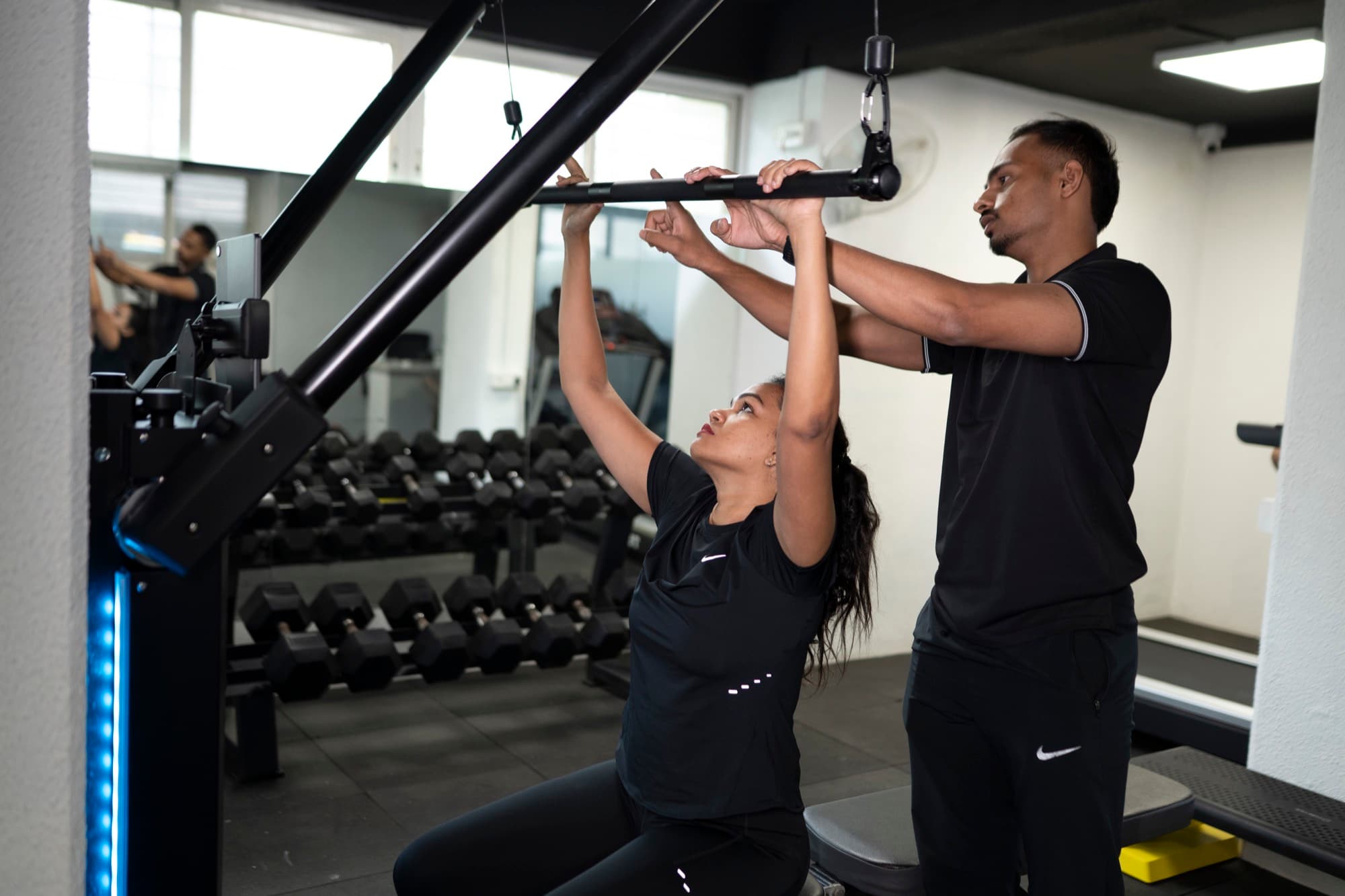
For a lot of women, the room is not a detail — it decides whether training happens at all.
From this guide — the FIT360 blog
Why the training environment is part of what you are buying
For a lot of women, the room is not a detail — it decides whether training happens at all. You can hire the most qualified coach in the city, but if the space makes you self-conscious every time you walk in, the sessions quietly stop. So the environment is a real evaluation criterion, not a nice-to-have.
When you assess a place, ask the concrete questions: During my session, who else is in the room? Can I attempt a heavy lift without an audience? Is there a private space, or am I on a shared floor? Can I train with a female coach, or in a women-only slot, if I want to? These are the things that decide whether you will actually show up and train hard, which is the only thing that produces results.
This overlaps with how you would choose any fitness space — privacy, cleanliness, equipment, how supported you feel — and the same checklist applies whether you are comparing studios or gyms. If you are weighing options near you, our guide to picking the best gym in Kharadi walks through those how-to-choose questions in more depth.
What progress tracking should actually look like
A coach you are paying should be able to show you that something is changing — and "you look great" is not evidence. Good tracking is broader than the scale: strength that goes up, measurements that shift, energy through the day, how your clothes fit, how you move, sometimes progress photos. Weight alone is a poor and often misleading signal, especially when you are building muscle while losing fat.
Tracking is not admin — it is what makes coaching worth paying for. The reason supervised, adjusted training beats a plan you follow alone is that a coach uses what they see to keep loading you correctly: in a controlled study, directly supervised resistance training produced significantly greater strength gains than unsupervised training, because supervised lifters progressed to heavier loads over time (PubMed). A trainer who tracks nothing is, functionally, an expensive workout playlist.
Reading the price: bundled vs à-la-carte
Prices for personal training are all over the place, and the number by itself tells you almost nothing — what matters is what sits inside it. Broadly, you will meet two structures, and knowing the difference stops you comparing a whole meal to a single ingredient.
- À-la-carte (the gym model). A membership, then a separate trainer fee, then — if you want it — a separate nutritionist. Three bills, and the trainer and the dietitian often never speak to each other.
- Bundled. One fee covers coaching, nutrition and programme design as a single package from one team that actually coordinates. The headline can look higher until you add up what the à-la-carte version really costs once everything is stacked.
So instead of chasing the lowest sticker price, ask what is included: Is nutrition part of this or extra? Who writes the plan, and how often is it adjusted? What is the cancellation policy? Then ask for a real number for your situation — honest pricing depends on the format you choose and what you need, so a straight conversation beats a figure plucked off a page.
How this maps onto FIT360
Everything above is the checklist we built FIT360 to pass. Your coaching is led by an ACE- and ACSM-certified trainer — accredited credentials, not a weekend course — and your nutrition by a clinical dietitian who is a Certified Diabetes Educator, so training and food come from one team that talks to each other. Several of our coaches are women, so if you would prefer to train with a woman, just ask. Every session is private and one-on-one, the plan is continuously adapted to how your body is progressing, and for health conditions we coordinate with your doctor rather than guess. You can meet the team on our about page.
The full picture of how private, women-first coaching works here — the studio, the formats, the approach to the female body — lives on our main page for a personal trainer for women in Pune. And whether you train with us or someone else, take this guide with you: ask about the certification, insist on a real assessment, run the ten questions, and watch for the red flags. You deserve a coach genuinely qualified to earn your trust.
Ready to see it for yourself? Book a free consultation — no pressure, just an honest conversation about your body and your goal.
Everything here comes from the same team that runs our one-on-one coaching in Kharadi. If you want a plan built around your body rather than a template, the first session is free.
Your First Session Is Free. The Studio Is Yours.
Walk through the door at Grant Rd, EON Free Zone. Meet Lucky. Meet Ekta. Spend an hour understanding where you are right now, and what the next 12 weeks could look like. There is no obligation — and no sales pitch. If FIT360 is not the right fit for what you need, we will say so.
Prefer we call you? Leave your details and we’ll call you back.
FIT360 Personal Training Studio · Grant Rd, EON Free Zone, Kharadi, Pune 411014 · Sessions by appointment
appointment