The desk-bound professional. Long hours seated at EON, WTC, or Gera Commerzone load the lower spine and shorten the hips — a classic recipe for sciatic irritation. We rebuild movement into your day and strengthen what sitting has switched off.
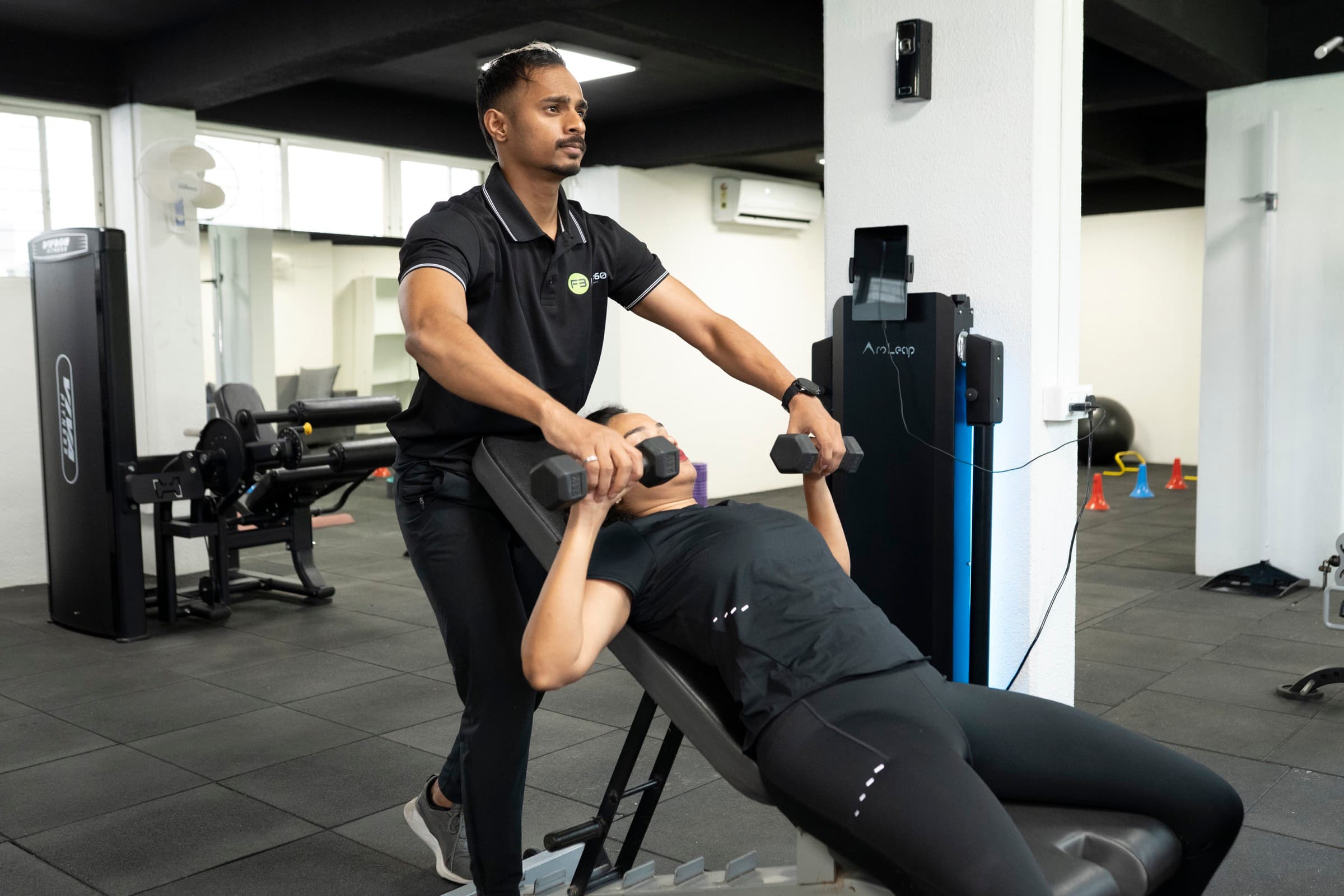
Sciatica relief · doctor-coordinated · Pune
Sciatica Relief Exercise Programme in Pune: Supervised Movement That Helps You Move Again
A structured, doctor-coordinated exercise programme for sciatica — built around your body and your pain, in a private Kharadi studio or at your home with the equipment delivered to your door.
- ACE- & ACSM-certified coaching·
- Doctor-coordinated·
- Rated 4.9★ on Google·
- Kharadi, Pune
You know the feeling. You stand up after a long stretch at your desk in EON, or you climb out of the car after the commute home, and a hot line of pain shoots from your lower back, through your buttock, down the back of your leg. Sitting makes it worse. You’ve been told to “rest it” — so you’ve been lying low, avoiding movement, waiting for it to pass. And somehow it isn’t passing.
Here’s what most people in Pune are never told: for the vast majority of sciatica, lying still is the opposite of what helps. Your sciatic nerve — the thick nerve that runs from your lower spine down each leg — usually gets irritated by pressure from a disc or tight surrounding muscles. The evidence is clear that gentle, gradually progressed movement, not bed rest, is what helps most people recover. That’s exactly what a sciatica relief programme in Pune at FIT360 gives you: supervised, paced movement, coordinated with your doctor, that helps calm the pain and rebuild the strength that stops it coming back.
In short: a sciatica relief programme is a structured, supervised exercise plan — coordinated with your doctor — that helps reduce leg pain, restore normal movement, and strengthen your back and core so flare-ups are less likely. At FIT360 it’s delivered one-on-one in a private Kharadi studio or at home, and it is coaching that supports your medical care, not a replacement for a doctor or physiotherapist.
01 — Why waiting it out backfires
Why Rest and Painkillers Alone Don’t Fix Sciatica
When your leg is on fire, the instinct is to freeze. Lie down, don’t move, take a painkiller, wait it out. It feels sensible. But for ordinary sciatica it usually backfires — and understanding why changes how you recover.
A painkiller can quiet the pain signal for a few hours. It does nothing about the actual situation: an irritated nerve, muscles that have tightened and gone protective around your spine, and a core that has switched off because moving hurt. Rest for more than a day or two makes each of those worse — muscles deconditioned, joints stiffer, the nerve no more settled than before. The NHS is blunt about this: with sciatica you should carry on with your normal activities and start gentle exercise as soon as you can, because even if moving hurts a little, it is not harmful and can help you get better faster — while prolonged bed rest tends to slow recovery down.
That’s the mechanism worth holding onto: hurt is not the same as harm for ordinary movement. Gentle, well-chosen movement helps the nerve settle, keeps the tissues around it supple, and switches your stabilising muscles back on. This isn’t a fringe idea — the UK’s national clinical guidance (NICE) recommends a structured exercise programme plus staying active for low back pain with or without sciatica. The catch is the word structured. Random stretches you found online can just as easily aggravate the nerve. What helps is the right movements, at the right load, progressed at the right pace — supervised by someone watching your body respond. That’s the difference between “exercise” and a programme.
The principle
Hurt is not the same as harm for ordinary movement.
02 — The honest comparison
Supervised Programme vs Bed Rest vs Random Stretches vs a Directory Trainer
When sciatica hits, you really only have a handful of options in front of you — and they are not the same thing. Here’s the honest comparison.
What matters
FIT360 supervised programme
Bed rest + painkillers
Random stretches / an app
Freelance trainer (directory)
Addresses the cause or just the symptom?
Rebuilds movement & strength around the nerve
Masks the pain only
Hit-or-miss; can aggravate it
Varies widely
Movements chosen for your sciatica
Yes — assessed, then paced to your tolerance
No movement at all
Generic, one-size-fits-all
Sometimes
Someone watching how your body responds
Yes — one coach, full attention
No
No
Often at a busy gym
Coordinates with your doctor / physio
Yes — doctor-coordinated
N/A
No
Rarely
Knows the red flags and when to stop
Yes — screened before and during
No guidance
No
Varies
Adapts as your pain changes week to week
Yes — continuously adjusted
No
No
Rarely
Rebuilds strength to lower recurrence
Yes — progressive core & posterior chain
No — leaves you deconditioned
No
Sometimes
Trainer, nutritionist & plan — one fee
All included, one team
N/A
No human
Trainer only; diet extra
Your full hour, no waiting
Yes — the studio is yours
N/A
N/A
Often a busy gym
Addresses the cause or just the symptom?
- FIT360 programme
- Rebuilds movement & strength around the nerve
- Bed rest + painkillers
- Masks the pain only
- Random stretches / app
- Hit-or-miss; can aggravate it
- Freelance trainer
- Varies widely
Movements chosen for your sciatica
- FIT360 programme
- Yes — assessed, then paced to your tolerance
- Bed rest + painkillers
- No movement at all
- Random stretches / app
- Generic, one-size-fits-all
- Freelance trainer
- Sometimes
Someone watching how your body responds
- FIT360 programme
- Yes — one coach, full attention
- Bed rest + painkillers
- No
- Random stretches / app
- No
- Freelance trainer
- Often at a busy gym
Coordinates with your doctor / physio
- FIT360 programme
- Yes — doctor-coordinated
- Bed rest + painkillers
- N/A
- Random stretches / app
- No
- Freelance trainer
- Rarely
Knows the red flags and when to stop
- FIT360 programme
- Yes — screened before and during
- Bed rest + painkillers
- No guidance
- Random stretches / app
- No
- Freelance trainer
- Varies
Adapts as your pain changes week to week
- FIT360 programme
- Yes — continuously adjusted
- Bed rest + painkillers
- No
- Random stretches / app
- No
- Freelance trainer
- Rarely
Rebuilds strength to lower recurrence
- FIT360 programme
- Yes — progressive core & posterior chain
- Bed rest + painkillers
- No — leaves you deconditioned
- Random stretches / app
- No
- Freelance trainer
- Sometimes
Trainer, nutritionist & plan — one fee
- FIT360 programme
- All included, one team
- Bed rest + painkillers
- N/A
- Random stretches / app
- No human
- Freelance trainer
- Trainer only; diet extra
Your full hour, no waiting
- FIT360 programme
- Yes — the studio is yours
- Bed rest + painkillers
- N/A
- Random stretches / app
- N/A
- Freelance trainer
- Often a busy gym
Only one of these does the actual job: settle the pain, restore your movement, and strengthen you so it’s less likely to come back — with a qualified coach watching, in coordination with your doctor.
03 — How it’s built
How Your Sciatica Programme Is Built — and Paced to Your Pain
The reason a structured programme beats going it alone is that it respects two things at once: your nerve needs to be nudged toward movement, and it must never be overloaded. Getting that balance right, session after session, is the whole skill.
01
It starts with an assessment — and a doctor check
Before a single exercise, we screen you. What movements ease the pain, what aggravates it, how far it radiates, your history, and — critically — whether any red-flag signs are present (see the box below). If you haven’t been assessed by a doctor or physiotherapist yet, that comes first; we coordinate with them so the exercise side is safe for your spine.
02
Movement first, load later — paced to tolerance
Early on, the goal isn’t to make you strong; it’s to help the nerve settle and get you moving comfortably again — gentle mobility, positions that decompress rather than provoke, and walking. As pain eases, we add gradual, progressive loading for the core, glutes, and posterior chain — the muscles that actually support your lower back. The load only goes up as your body earns it. This is the movement-based, structured approach that a meta-analysis of supervised exercise for sciatica found gives a small short-term benefit over advice alone — real, but modest, which is exactly why we’re honest about it rather than promising miracles.
03
A plan that changes as your pain does — and an hour with no waiting
Sciatica is not linear. Some weeks are better, some flare. That’s why your plan is not a fixed PDF handed to you on day one — it’s continuously adapted to where your body is right now: how the pain is behaving, what’s provoking it, how you’re recovering, your real life.
And because every session is one coach and one client in a private studio, there’s no waiting for equipment — your full, optimised hour goes into moving well, not queuing. When movement already hurts, that focused, unhurried attention matters more, not less.
04 — The nerve pathway
Where Sciatica Travels — and Why Movement Reaches It
A hot line of pain shoots from your lower back, through your buttock, down the back of your leg. Your sciatic nerve — the thick nerve that runs from your lower spine down each leg — usually gets irritated by pressure from a disc or tight surrounding muscles.
- 01Lower back“from your lower back”
- 02Buttock“through your buttock”
- 03Back of the leg“down the back of your leg”
- 04The sciatic nerve“the thick nerve that runs from your lower spine down each leg”
- 05What irritates it“irritated by pressure from a disc or tight surrounding muscles”
Fig. 01 — the sciatic path (illustrative)
Lower back → glute → hamstring → calf → foot
⚠️ Red flags — when it is an emergency, not a training session
Stop and get emergency medical care immediately (call your local emergency number or go to the nearest A&E / hospital emergency department) if your sciatica comes with any of these signs. These can point to a serious condition called cauda equina syndrome, which needs urgent treatment:
- Numbness or tingling around your saddle area — the genitals, anus, or inner thighs (the parts that would touch a saddle).
- New problems controlling your bladder or bowel — you can’t pee, you can’t feel when you need to, or you leak / lose control.
- Severe or getting-worse weakness or numbness in both legs, or difficulty walking or standing.
Also see a doctor promptly — and do not start or continue an exercise programme until you have — if your back pain follows a significant injury or fall, or comes with fever, unexplained weight loss, or you have a history of cancer.
A training session is never the answer to any of the above. FIT360 screens for these signs before and during your programme, and we will send you to a doctor, not a workout, the moment they appear.
05 — Who it’s for
Who This Sciatica Programme Is For
Sciatica has a handful of very common triggers, and we build around each of them:
The driver / long commuter. Hours behind the wheel — cab drivers, sales roles, anyone with a punishing Pune commute — keep the spine in one flexed position under vibration. Targeted mobility and strength counter exactly that pattern.
Pregnancy-related sciatica. The load and posture changes of pregnancy can press on the sciatic nerve. This needs especially gentle, appropriate movement — always coordinated with your obstetrician or doctor, never freelanced.
Recurrent or long-standing sciatica. If it keeps coming back, the missing piece is usually the strength and movement habits that prevent the next flare. That's the part a structured programme is built to fix.
If your sciatica traces back to a disc problem, you may also want to read about our back pain & slip disc programme — the two often overlap, and we’ll point you to the right starting place at your consultation.
06 — Nutrition included
Nutrition That Supports Recovery — Included, Not Sold Separately
Clinical dietitian, in the programmeNutrition won’t “cure” a nerve, and we won’t pretend it does. But it does two things that genuinely matter when you’re managing sciatica. Carrying less excess weight means less mechanical load through your lower spine, and a diet built to reduce inflammation supports the tissues around an irritated nerve as they calm down. Every FIT360 programme includes nutrition coaching from our clinical dietitian — built around home-cooked Indian food and your real routine, not a printout of “boiled chicken and broccoli.” Training and diet come from one team that actually talks to each other.
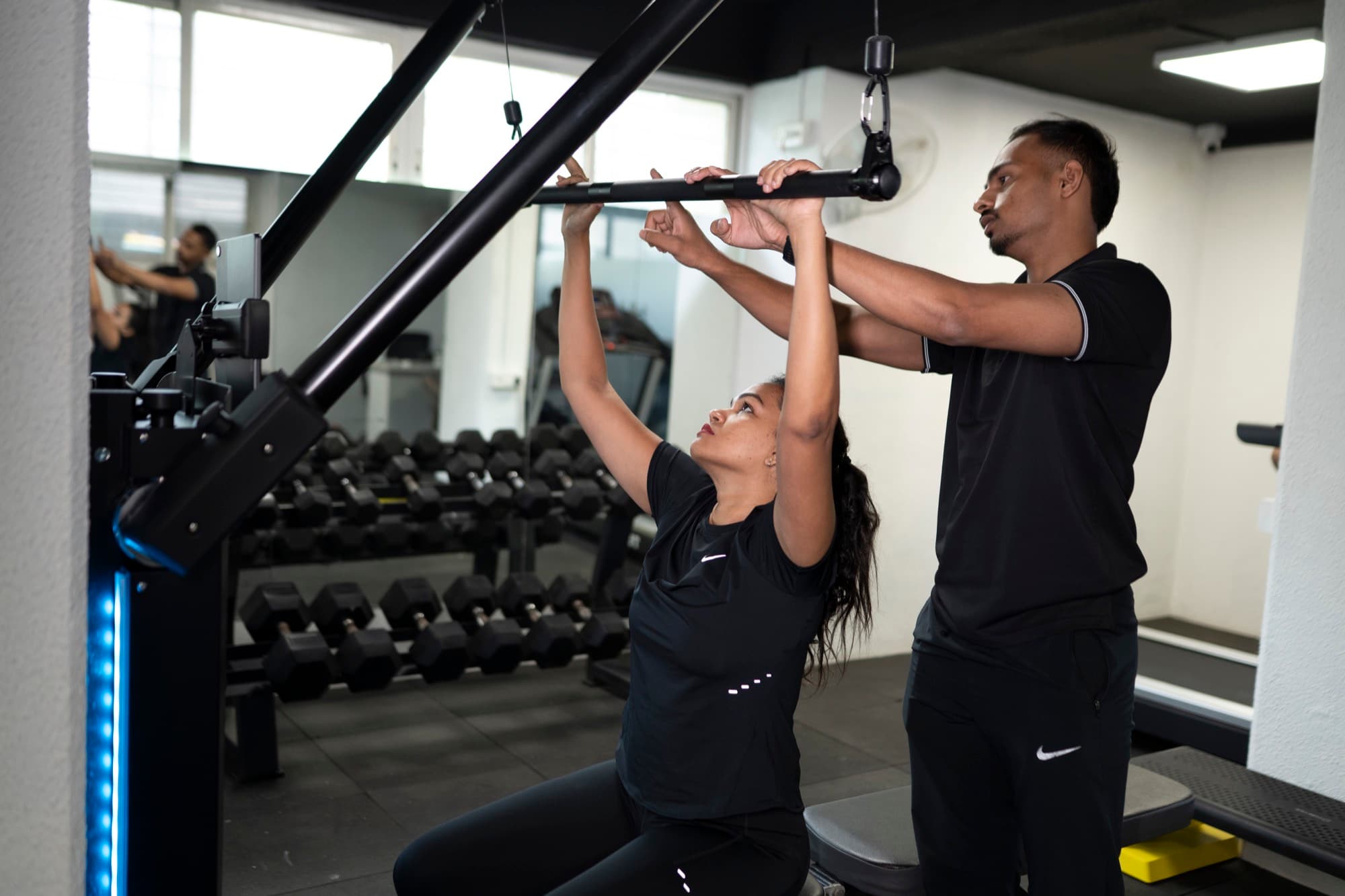
Supervised · paced · doctor-coordinated
Gentle, gradually progressed movement, not bed rest, is what helps most people recover.
07 — Meet your coach
Meet Your Coach — and Why We Built This
FIT360 exists because its founders — Debargha, Avinash, and Lucky — were time-poor people who wanted real, personal attention and couldn’t find it in a crowded gym. For anyone dealing with pain, that gap is even wider: the last place a sensitive back belongs is a busy floor where nobody is watching how your body responds. So they built the opposite — full attention, no waiting, science-backed, doctor-coordinated.
Lucky Parkhi — Personal Trainer & Exercise Programmer. An ACE- and ACSM-certified personal trainer (not a weekend course), he runs your assessment, designs your programme, and paces every session to how your pain is responding.
Ekta Kinger — Clinical Dietitian & Nutritionist. BSc in Exercise Science with an MSc in progress, a Certified Diabetes Educator with 14 years of experience in weight management, PCOD, diabetes, and gut health. Your nutrition is hers, and it's built into your programme.
For a condition like sciatica, this is the part a regular gym simply can’t offer: your doctor or physiotherapist guides the medical side, and we design and deliver the exercise around their advice. That bridge between medicine and movement is the whole point.

Lucky Parkhi · ACE + ACSM certified
Testimonial — pending client intake
[TESTIMONIAL — from intake: a real Pune client with desk-job sciatica who went from dreading their commute to moving comfortably again, with their own words and what changed.]
Clients on the programme
Rated 4.9★ on Google
Google review
“As someone with a hectic work schedule, finding time and motivation to work out was always a challenge. I joined Fit360 a few months ago, and it's honestly been a game changer. The workouts are short, effective, and customized to my fitness level. Highly recommend it to all working professionals.”
HA
Hussen Ali
Working professional · Kharadi
Google review
“Lucky Sir has been instrumental in my progress. There's no crowd at all — it genuinely felt like my personal gym. The homely, comfortable environment made such a difference in my recovery and progress. Fit360 delivered on their commitment: they promised results, and I genuinely achieved them.”
A
Ashwin
Long-term private client · Kharadi
Google review
“The personal studio experience is great and extremely goal oriented. Mr Lucky is professional and makes sure that every set and rep is completed with precision. He takes it upon himself that the client receives not only physical but nutritional guidance as well.”
AK
Aakanksha Kumar
Private studio client · Kharadi
08 — Honest about results
Doctor-Coordinated — and Honest About What to Expect
Let’s be straight about recovery, because honest coaching is the only kind worth paying for. Most sciatica improves gradually over weeks to months with conservative care — not overnight, and rarely in a straight line. A structured exercise programme helps, but the evidence says its benefit over simple advice is small and mainly short-term. So here is exactly what we will and won’t promise.
What we honestly aim for
Reduce your pain, restore your normal movement, and strengthen you so flare-ups are less likely — working alongside your doctor.
What we will never tell you
That we can “cure” your sciatica, “fix your disc,” give you “permanent relief,” or hit some guaranteed timeline or percentage. Anyone promising that is selling, not coaching.
FIT360 is supervised, doctor-coordinated movement coaching. It is not a diagnosis, and not a replacement for your doctor or physiotherapist. We screen you before you start, we keep them in the loop, and we send you back to them the moment anything needs it.
09 — Plans & formats
Plans, Formats, and How It Fits Your Life
Testimonial — pending client intake
[TESTIMONIAL — from intake: a recurrent-sciatica client who chose at-home training with equipment delivered, and what a doctor-coordinated programme changed for them — in their own words.]
One bundled monthly fee covers everything — your coach, your nutritionist, and your fully personalised, continuously-adapted programme. Not a membership, then a trainer fee, then a dietitian fee. One price, one team. What you pay depends only on the format you choose.
That format choice matters more than usual when movement hurts. In our private Kharadi studio, the whole space is yours for your slot. Or train at home — and here’s what makes ours different: we deliver the basic equipment to your house, enough to run your whole programme, so home training gets you the same result as the studio. When getting to a gym in a flare-up is the last thing you want to do, that’s a real advantage. See how at-home training works.
We won’t quote a number in a blog post, because the honest answer depends on your format and your goal. Book a free consultation and we’ll tell you exactly what’s realistic for you.
10 — FAQ
Questions — 09
Sciatica Programme FAQs
Straight answers on timelines, safety, and how the programme works — the honest version, coordinated with your doctor.
How long does sciatica take to heal?
Honestly, it varies — but most sciatica improves gradually over a few weeks to a few months with conservative care like staying active and structured exercise, rather than resting. Recovery is rarely a straight line; some weeks feel better than others. We can't promise a fixed timeline, and you should be wary of anyone who does. What we can do is give your recovery the best conditions and adjust as your body responds.
What exercises should I avoid with sciatica?
It depends on your specific case, which is exactly why generic advice is risky. In general, early on we avoid movements that clearly provoke the pain down your leg — often heavy or repeated forward bending, deep twisting under load, and anything that increases the radiating pain. But the same movement that aggravates one person's sciatica can help another's, so the right answer comes from your assessment, not a list off the internet.
Can sciatica be cured permanently?
We won't use the word "cure," and we'd be cautious of anyone who does. Most sciatica settles with conservative care, and building strength and better movement habits genuinely lowers the chance of it coming back — but there's no guarantee of permanent relief. Our honest aim is to reduce your pain, restore your movement, and strengthen you so flare-ups are less likely, coordinated with your doctor.
What's the difference between sciatica and a slip disc?
Sciatica describes the symptom — pain, tingling, or numbness that travels along the sciatic nerve, usually down one leg. A slipped (herniated) disc is one common cause of that symptom, when disc material presses on the nerve, though sciatica can have other causes too. They overlap a lot, which is why our back pain & slip disc programme and this one are closely related. Your doctor’s diagnosis tells us which starting point is right for you.
Is it safe to exercise when it still hurts?
For ordinary sciatica, gentle movement is generally safe and helpful even when it's uncomfortable — the NHS advises staying active rather than resting in bed, because moving usually isn't harmful and can speed recovery. The important exception is the red-flag signs listed on this page (loss of bladder or bowel control, saddle-area numbness, or severe/worsening leg weakness) — those are a medical emergency, not a training situation. We screen for them before and during your programme.
Can I do the programme at home?
Yes. We offer at-home training and deliver the equipment to your house, so you get the same supervised programme and the same results as the studio — useful when a flare-up makes travelling the last thing you want to do.
Do you coordinate with my doctor or physiotherapist?
Always, for a condition like this. Your doctor or physio guides the medical side and the diagnosis; we design and deliver the exercise around their advice. We're movement coaching that supports your medical care, never a replacement for it.
Do I get a nutrition plan too?
Yes — nutrition coaching from our clinical dietitian is included in every programme. It won't cure a nerve, but reducing excess load on your spine and supporting your tissues with a sensible, anti-inflammatory, home-cooked Indian diet genuinely helps recovery.
Where are you, and how do sessions work?
Near EON Free Zone, Grant Road, Kharadi, Pune 411014 — minutes from EON IT Park, WTC, and Gera Commerzone, or at your home with equipment delivered. Sessions run by appointment, so you book a slot that fits your day and your pain rather than working around fixed gym hours.
Move Again — With a Coach Who Paces It to Your Pain.
Sciatica improves fastest when you keep moving the right way, at the right pace, with someone watching how your body responds. If you're ready to stop waiting it out on the sofa and start recovering properly — safely, and in coordination with your doctor — we'd love to help. Book your free consultation — no pressure, just a real conversation about your sciatica and what's realistic for you.
Prefer we call you? Leave your details and we’ll call you back.
FIT360 Personal Training Studio · Grant Rd, EON Free Zone, Kharadi, Pune 411014 · Sessions by appointment
Your slot, your studio
Sessions by
appointment
appointment
Call
+91 7397951908Email
contact@fit360.studioStudio
Grant Rd, EON Free Zone, Kharadi, Pune 411014