What Is PCOD and How Should You Train With It?
A mechanism-first guide to training with PCOD — what the condition is, how exercise improves insulin sensitivity, the weekly shape that works, and the myths to drop.
If you have PCOD, you have almost certainly been told to "just lose weight and exercise" — and then left to figure out what that actually means for a body that does not seem to play by the usual rules. This guide fixes that. It explains what PCOD really is, why exercise is the single most powerful lever you have, and exactly how to train with it.
The short version: PCOD cannot be cured, but it is very manageable, and well-chosen training genuinely changes the underlying biology — mainly by improving how your body handles insulin. Everything below is built on that mechanism, not on hype, and every clinical claim is linked to its evidence.
What PCOD actually is — and why the name confuses everyone
PCOD stands for Polycystic Ovarian Disease. In everyday Indian usage it is used almost interchangeably with PCOS (Polycystic Ovary Syndrome), and that overlap is the first thing worth clearing up, because the naming causes a lot of unnecessary worry.
Clinically, the internationally recognised term is PCOS — a hormonal condition where the ovaries and the body's hormone signalling do not work quite as they should, affecting cycles, skin, hair, mood and fertility. "PCOD" is the label most commonly used in India for the same broad picture. For the purpose of how you train and eat, treat them as the same condition: what helps one helps the other. Your doctor's diagnosis is what matters, not which of the two words appears on your report.
It is also far more common than most women realise. The World Health Organization estimates that PCOS affects 10–13% of reproductive-aged women, and that up to 70% of affected women worldwide remain undiagnosed. If you have it, you are very much not alone.
The symptoms you are probably living with
- Irregular, unpredictable or missed periods
- Weight that gathers around the middle and refuses to shift
- Acne, oily skin, or unwanted hair growth (and sometimes thinning on the scalp)
- Fatigue, low energy, and mood swings
- Difficulty losing weight despite genuinely trying
These are not separate, random problems. Most of them trace back to one shared root — and that root is exactly where training does its best work.
The real engine: insulin resistance — and how training rewires it
Here is the mechanism that explains almost everything about PCOD, and why exercise matters so much. Many women with PCOS have insulin resistance: their cells respond poorly to insulin, so the body pumps out more of it to keep blood sugar in check. The NHS notes the condition may be linked to hormones such as insulin and testosterone not working properly.
Those high insulin levels are not harmless background noise. They push the ovaries to make more androgens (male-type hormones), which is what drives the acne, the unwanted hair, and the disrupted cycles. High insulin also makes fat storage easier and fat loss harder — which is why the usual "eat less, run more" advice so often fails here. It is not a willpower problem. It is a physiology problem.
Now the good news, and it is genuinely good. Exercise is the most powerful lever you have for PCOD because of what it does to insulin — not because of how many calories it burns. When a muscle contracts, it can pull glucose out of your blood through a door called GLUT4 — and it opens that door without needing insulin at all. As the physiology review by Richter and Hargreaves describes, muscle contraction triggers GLUT4 to move to the cell surface through a pathway independent of insulin, and exercise training is the most potent stimulus to increase GLUT4, which may partly contribute to improved insulin action.
That is the whole point. Every session is a temporary insulin bypass — your muscles clear sugar on their own — and over weeks, training builds more of those doors, so your body needs less insulin to do the same job. Lower insulin means lower androgen pressure, which is the domino that can improve skin, hair, energy and cycles over time.
This is why exercise works. In women with PCOS specifically, a systematic review by Kite and colleagues found that exercise (alone or with diet) reduced fasting insulin and HOMA-IR (a measure of insulin resistance) and improved cholesterol and body composition — while the authors were honest that many effects were modest and the evidence quality varied. That honesty matters: this is real, but it is a steady lever, not a magic switch.
What training actually works for PCOD
The condition points to a clear priority: build and use muscle, and keep your heart working regularly. Muscle is your biggest site for clearing glucose, so more of it — and more demand on it — directly improves insulin sensitivity. Here is how the main tools compare, and what each is really for.
| Training type | What it does for PCOD | A sensible starting shape |
| Strength training | Builds muscle (more GLUT4 doors), the strongest long-term driver of insulin sensitivity and body composition | 2–3 sessions/week, full-body, compound moves, progressed over time |
| Zone-2 cardio | Easy, conversational-pace cardio that improves fat use and insulin sensitivity without spiking stress | About 150 min/week, spread across most days (a brisk walk counts) |
| Intervals / HIIT | Time-efficient way to improve fitness and insulin sensitivity — useful, but easy to overdo | Optional, 1 short session/week once the base is in place |
| Yoga & mobility | Lowers stress load, supports recovery and sleep, keeps you consistent | As needed, especially on lower-energy days |
Notice what the priority is not: hours of punishing cardio. The old idea that you must grind out endless treadmill time is one of the most counterproductive things you can do with PCOD, and we will come back to why.
How hard should you actually work?
Effort matters more than any specific exercise. For strength, work in a range where the last two or three reps of a set feel genuinely challenging but your form holds — roughly the last two reps "in reserve." Somewhere around 8–15 reps per set is a practical zone for most people building muscle and using it well. Progress gradually: a little more weight, a rep or two more, over weeks.
For zone-2 cardio, the test is simple — you should be able to hold a conversation but not sing. If you are gasping, that is not zone 2. This easy pace is the point: it delivers the metabolic benefit without adding the stress load that PCOD bodies are often already carrying too much of.
One honest caveat on structure: these are sensible starting points, not a prescription for your body. The 2023 international PCOS guideline (Teede and colleagues) is clear that a healthy lifestyle of physical activity and healthy eating is central to managing PCOS, but the exact mix, load and progression should be matched to how your body responds — which is precisely what supervised coaching is for. If you want that built around you, our PCOD/PCOS fitness programme in Pune is designed to do exactly this.
Cycle-aware training: working with your energy, not against it
Some days you feel strong; other days a warm-up feels like a mountain. That is not laziness — hormones genuinely shift how you feel and perform across a cycle. Broadly, energy and strength tend to run higher in the first half (the follicular phase, as estrogen rises) and dip in the days before a period (the luteal phase). Training a little harder when you feel good and pulling back when you do not is a smart, sustainable rhythm.
But here is the PCOD-specific honesty: because PCOD often means irregular or absent ovulation, fixed "cycle-syncing" calendars usually do not fit. So do not train by a date on an app — train by how your body actually feels. A simple habit of noting your energy each day tells you more than any generic phase chart.
This flexibility is the whole philosophy at FIT360: a plan that reads how you are actually responding and adjusts, rather than a static PDF you are handed once and stuck with. That is especially valuable with a condition that does not stand still.
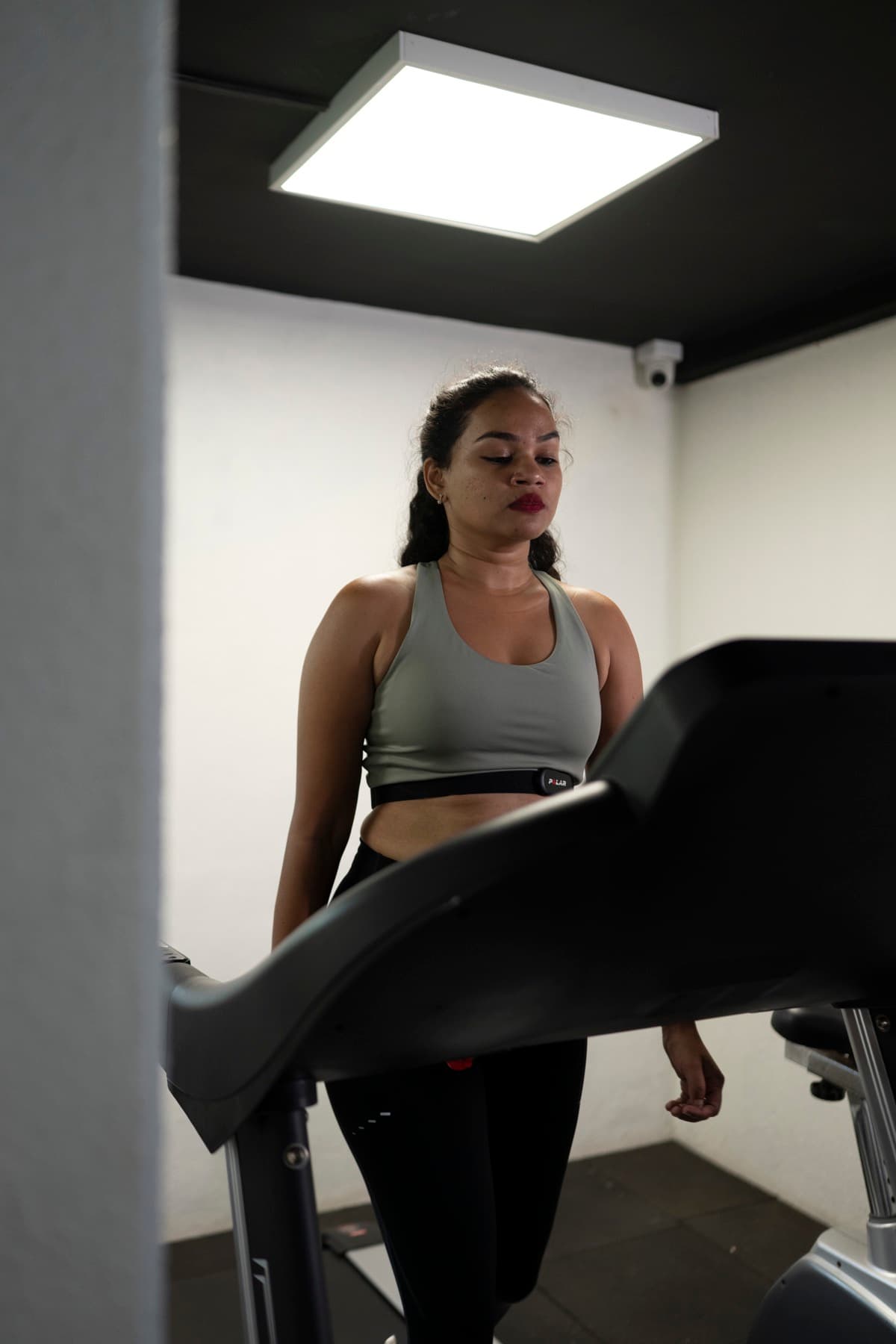
Exercise is the most powerful lever you have for PCOD because of what it does to insulin — not because of how many calories it burns.
From this guide — the FIT360 blog
Nutrition that works with your training — built around Indian food
You cannot out-train PCOD nutrition, and you cannot fix it with a printout of "boiled chicken and broccoli." Training improves your insulin sensitivity; food decides how hard your insulin system has to work in the first place. They are partners, and both are built around the same goal: steadier blood sugar and steadier insulin.
The practical shape is not exotic, and it does not require abandoning Indian food. It is the roti, dal, sabzi and rice you already eat — arranged a little more thoughtfully:
- Protein at every meal — dal, paneer, curd, eggs, chicken or fish. Protein blunts the blood-sugar spike and protects the muscle you are building.
- Fibre first — plenty of vegetables and whole grains, which slow sugar release so insulin does not have to surge.
- Fewer refined carbs and added sugar — maida, sugary chai and sweets are the sharpest insulin spikes, so they are the highest-value things to reduce.
- Healthy fats in sensible amounts — nuts, seeds and good oils help you feel full and steady.
The aim is calm, sustainable change — not a crash diet you abandon in a fortnight. Even a modest amount of weight loss, for women who are carrying extra, can meaningfully help symptoms and insulin sensitivity, which is why both the NHS and the international guideline put diet, activity and — where relevant — weight management at the front of PCOS care. If you want a plan built around your kitchen and your routine, this is what our nutrition coaching in Pune is for, led by a Certified Diabetes Educator whose specialism is exactly this.
PCOD training myths — and why they are wrong
Myth: "Do hours of cardio to lose the weight."
Why it is wrong: long, punishing cardio raises your stress load, and chronic stress works against PCOD. It also skips the highest-value tool — strength training — which builds the muscle that improves insulin sensitivity for good. Smart, moderate, mixed training beats grinding cardio every time.
Myth: "Lifting weights will make me bulky or worsen PCOD."
Why it is wrong: the opposite is true. Strength training is one of the most effective tools for PCOD precisely because muscle clears glucose and improves insulin action. Women do not "bulk up" easily, and building muscle is exactly what a PCOD body benefits from.
Myth: "You cannot train on a bad hormonal week."
Why it is wrong: you do not stop, you scale down. A gentle walk, mobility work, or a lighter session keeps consistency alive — and consistency, not intensity, is what moves the needle over months.
Myth: "Exercise can reverse or cure PCOD."
Why it is wrong: there is no cure, and anyone promising a guaranteed "reversal" is overselling. What is true and well-evidenced is that training and nutrition can manage the condition — improving insulin sensitivity, symptoms, energy and cycles for many women. That is not a small word; it can genuinely change how you live.
When to see a doctor — and why PCOD training should be doctor-coordinated
Exercise and nutrition are powerful, but they sit alongside medical care, never instead of it. PCOD is a medical diagnosis, and some of its knock-on risks — insulin resistance, higher long-term risk of type-2 diabetes, and effects on fertility — need a doctor's oversight. See or stay in touch with your doctor or gynaecologist if:
- You suspect PCOD but have not been formally diagnosed — get the diagnosis first.
- Your periods are very irregular, extremely heavy, or have stopped.
- You are trying to conceive, or fertility is a concern — this is firmly your gynaecologist's lead.
- You have been prescribed medication such as metformin, or your blood tests show insulin or cholesterol concerns.
- You have any other health condition that affects how you should exercise.
A good fitness programme respects this line. At FIT360, health-condition training is doctor-coordinated: your doctor manages the medicine, and we design and deliver the supervised exercise and nutrition that supports it. We never replace or override a prescription, and on fertility your gynaecologist always leads. The overlap between PCOD and blood-sugar health is also why the same careful, doctor-coordinated approach runs through our diabetes management programme in Pune.
What realistic progress actually looks like
Set your expectations honestly and you are far more likely to stick with the thing that works. PCOD progress is rarely a straight line, and the scale is one of the least useful ways to measure it.
In the first few weeks, the changes are usually how you feel — better energy, better sleep, a bit more strength. Body composition and blood-marker changes take longer, typically building over a few months of consistency. Some women see cycles become more regular; for others the biggest wins are metabolic and energy-related. Importantly, the WHO notes that healthy eating and physical activity are important for all women with PCOS, even if they do not lead to weight loss — so measure strength, energy, measurements, cycle patterns and how you feel, not only kilos.
This is why we track progress beyond the scale, in a private studio where the focus is entirely on you. If a crowded gym floor has ever felt like the wrong place to work on this, a personal trainer for women in Pune — with the option to train with a female coach — changes the experience completely. And if steady, sustainable fat loss is your main goal within all of this, our weight-loss trainer in Pune approach uses the very same insulin-first logic.
Frequently asked questions
Is PCOD the same as PCOS?
In everyday Indian use, yes — the terms are used interchangeably for the same broad hormonal condition. Clinically, PCOS is the internationally recognised name. For how you should train and eat, treat them as identical; what helps one helps the other.
Can exercise cure or reverse PCOD?
No — there is no cure, and no honest coach will promise a "reversal." But exercise and nutrition can genuinely manage PCOD: improving insulin sensitivity, body composition, energy and, for many women, cycle regularity. That is a real, meaningful change, just not a magic one.
What is the single best type of exercise for PCOD?
If you had to pick one, strength training — because building muscle is the strongest long-term driver of insulin sensitivity. In practice, the best results come from combining strength with regular easy (zone-2) cardio, matched to how your body responds.
How often should I work out with PCOD?
A sensible starting shape is 2–3 strength sessions plus around 150 minutes of easy cardio across the week, with recovery built in. This is a starting point, not a fixed rule — the right amount depends on your fitness, symptoms and recovery.
Why is losing weight so hard with PCOD?
Because insulin resistance makes fat storage easier and fat loss slower — it is physiology, not a lack of effort. The fix is training that improves insulin sensitivity plus nutrition that keeps insulin steady, rather than extreme dieting, which usually backfires.
Will training help make my periods regular again?
It can, for many women — mostly by improving insulin sensitivity and supporting a healthy weight. It is not guaranteed for everyone, and cycle regularity is something your doctor should also track alongside your training.
Should I train with PCOD without seeing a doctor first?
Get a proper diagnosis and medical guidance first, especially if fertility is a concern or you are on medication. The safest and most effective approach is doctor-coordinated: your doctor leads on the medical side, and your coach designs the supervised exercise and nutrition around it.
Key takeaways
- PCOD/PCOS has no cure, but it is very manageable — and lifestyle is the most evidence-backed lever you have.
- Insulin resistance is the engine. Exercise helps mainly by improving insulin sensitivity — muscle clears glucose without insulin, and training builds more capacity to do so.
- Prioritise strength plus easy cardio over hours of punishing exercise, and progress gradually.
- Train by how you feel, not by a fixed cycle calendar — PCOD cycles are often irregular.
- Food and training are partners — build meals around real Indian food that keeps insulin steady.
- Keep it doctor-coordinated, measure progress beyond the scale, and be patient — the changes that last are the steady ones.
If you want this built around your body, your cycle and your kitchen rather than a template, that is exactly what we do. Book a free consultation and we will talk honestly about what is realistic for you — no pressure, no over-promises.
Everything here comes from the same team that runs our one-on-one coaching in Kharadi. If you want a plan built around your body rather than a template, the first session is free.
Your First Session Is Free. The Studio Is Yours.
Walk through the door at Grant Rd, EON Free Zone. Meet Lucky. Meet Ekta. Spend an hour understanding where you are right now, and what the next 12 weeks could look like. There is no obligation — and no sales pitch. If FIT360 is not the right fit for what you need, we will say so.
Prefer we call you? Leave your details and we’ll call you back.
FIT360 Personal Training Studio · Grant Rd, EON Free Zone, Kharadi, Pune 411014 · Sessions by appointment
appointment